In the immediate aftermath of World War II, two-wheeled motorized vehicles were strictly utilitarian. Early motor scooters were little more than reinforced bicycles with tiny engines slapped onto their frames or crude contraptions built from surplus military parts. They were loud, dirty, unstable, and notoriously oily. Then, in 1946, Piaggio unveiled the Vespa 98—and instantly rendered every existing scooter obsolete.
The original Vespa was not merely an improvement on existing motorbikes; it was a total structural and conceptual reinvention. But what exactly made Corradino D’Ascanio’s creation so fundamentally different from everything else on the road?
1. Designed by an Aeronautical Engineer Who Hated Motorcycles
Most motorcycles and scooters of the 1940s were created by bicycle manufacturers or mechanical technicians who built incrementally on existing frame designs. Enrico Piaggio, however, appointed Corradino D’Ascanio—an aeronautical engineer who had spent his career designing helicopters and fighter aircraft.
Crucially, D’Ascanio intensely disliked conventional motorcycles. He found them bulky, uncomfortable, difficult to mount, and notorious for staining trousers with grease from exposed chains. Because he refused to start with a traditional motorcycle layout, he approached the problem as if designing a compact aircraft fuselage.
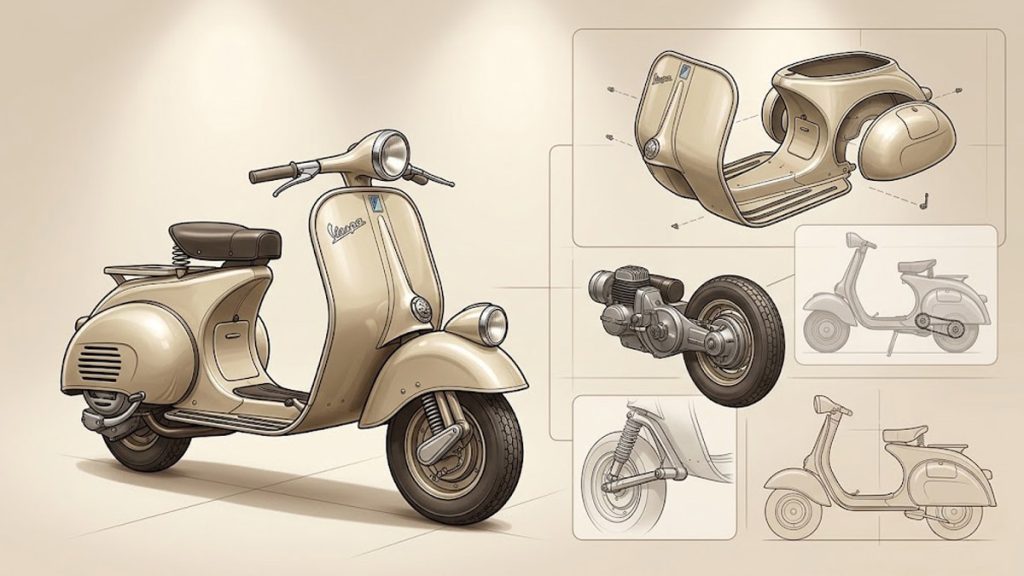
2. The Aircraft-Inspired Pressed-Steel Monocoque Frame
Every other scooter relied on a tubular steel skeleton wrapped in thin decorative body panels. D’Ascanio threw away the tubular frame entirely, introducing the world’s first pressed-steel monocoque body (unibody) for a two-wheeler:
- Structural Shell: The outer metal body itself acted as the load-bearing frame, making the vehicle exceptionally rigid, lightweight, and durable.
- Rider Shield: The front leg shield integrated seamlessly into the body, protecting the rider’s legs and footwear from flying mud, water, and road debris.
- Complete Cleanliness: Unlike open-chain motorbikes, the Vespa’s body completely encapsulated all mechanical parts, allowing commuters to ride in formal business wear or dresses without fear of oil splatter.
3. Direct-Drive Engine: Goodbye Chains & Belts
In conventional 1940s motorbikes, the engine sat in the middle of the frame, connected to the rear wheel via long, exposed drive chains or rubber belts that required constant tensioning and lubrication. D’Ascanio eliminated this primary source of mechanical failure:
- Direct-Mounted Engine Unit: The Vespa’s 98cc engine was mounted directly onto the right side of the rear wheel hub. Power was transferred directly through a gear mesh without any chains, belts, or external drives, drastically reducing mechanical complexity and maintenance.
- Enclosed Wheel Swap Capability: Because the engine was offset on one side, D’Ascanio designed a single-sided rear swingarm. For the first time on a scooter, changing a flat tire was as quick and effortless as changing a wheel on a car.
4. Aircraft-Style Single-Sided Front Suspension
Standard motorcycles used heavy dual-fork front suspensions derived from bicycles. D’Ascanio drew directly from airplane landing gear design to engineer a single-sided front trailing arm suspension. This layout made front wheel removal remarkably simple while absorbing harsh post-war cobblestone roads with unprecedented smoothness.
5. True Step-Through Ergonomics & Handlebar Gear Shift
Before the Vespa, riding a motorbike meant straddling a hot central fuel tank and operating gear levers with your feet. The Vespa introduced two ergonomic breakthroughs:
- Chair-Like Seating: A wide, flat floorboard and open step-through design meant riders sat upright comfortably—no straddling required.
- Handlebar Twist-Gear Shift: The 3-speed manual transmission was operated by twisting the left handlebar grip while pulling the clutch, keeping the rider’s feet resting flat and clean on the deck.
Architectural Comparison: Original Vespa vs. Traditional 1940s Scooters
| Design Element | Traditional 1940s Scooter | Original Vespa 98 (1946) |
|---|---|---|
| Frame Architecture | Tubular steel frame with separate panels | Pressed-steel monocoque (unibody) shell |
| Drivetrain | Exposed chain or belt drive from central engine | Direct-drive engine unit mounted to rear hub |
| Front Suspension | Bicycle-style telescopic or rigid front fork | Aircraft-inspired single-sided trailing arm |
| Rider Protection | Minimal splash protection; exposed oil/grease | Full front leg shield & fully enclosed engine |
| Riding Position | Straddled frame; foot-operated gear shifters | Step-through seating; handlebar twist gear shift |
Conclusion: A Masterclass in Human-Centric Design
What made the original Vespa so different was not a single gimmick, but an unyielding commitment to human-centered design. By ignoring motorcycle tradition and solving real-world rider frustrations—dirt, inconvenience, and complexity—D’Ascanio created a timeless vehicle that didn’t just stand out from other scooters; it redefined what a two-wheeler could be.