When World War II came to an end in 1945, Italy lay in ruins. Major cities were devastated, manufacturing facilities destroyed, and the majority of the population could not afford a traditional motor vehicle. Amidst this bleak economic landscape, an extraordinary machine was born—one that did not merely solve a pressing mobility crisis, but permanently reshaped Italian culture and design history: the Vespa.
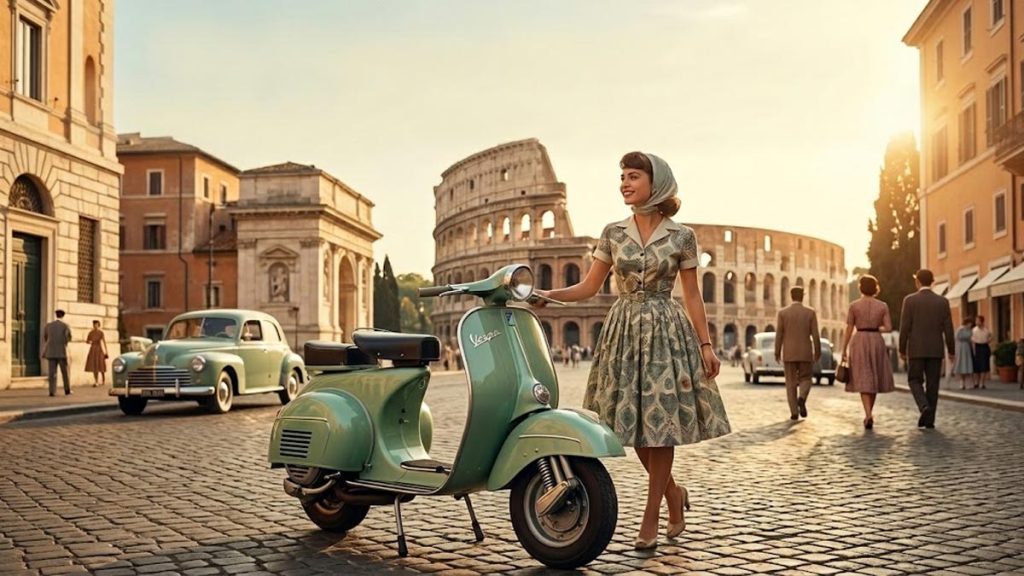
During what is now celebrated as the “Golden Age of Scooters” (spanning the 1950s and 1960s), the Vespa evolved far beyond its humble utilitarian roots. It became a global icon of personal freedom, sophisticated style, and national economic resurgence.
An Ingenious Solution from an Aircraft Factory
The visionary behind the Vespa was Enrico Piaggio, whose family company had previously manufactured fighter planes. With military aviation contracts dissolved following the war, Piaggio sought to create an affordable, mass-market vehicle to get Italians moving again.
To realize his vision, Piaggio hired Corradino D’Ascanio, an aeronautical engineer who famously disdained conventional motorcycles. D’Ascanio viewed standard motorbikes as dirty, uncomfortable, and impractical—their exposed chains splashed oil onto trousers, and their bulky frames made them nearly impossible for women wearing skirts to ride gracefully.
Applying principles from aircraft design, D’Ascanio conceived a revolutionary two-wheeler:
- Unibody Steel Construction: A pressed-steel monocoque body acted as a protective shield, safeguarding riders from road debris, rain, and engine grime.
- Enclosed Engine Mechanism: The engine was mounted directly onto the rear wheel and fully enclosed, eliminating messy drive chains and grease stains.
- Step-Through Flat Footboard: Allowing the rider to sit upright comfortably—as if sitting in a chair—the layout welcomed both men in tailored suits and women in dresses.
When Enrico Piaggio first saw the prototype with its narrow waist and heard its distinctive engine sound, he famously exclaimed: “Sembra una vespa!” (“It looks like a wasp!”). The name stuck immediately.
Why Did Everyone Want a Vespa?
The meteoric rise of the Vespa during Italy’s scooter boom rested on three pivotal catalysts that combined economic practicality with cultural aspiration:
- Affordability & Remarkable Fuel EfficiencyIn post-war Italy, automobiles like the Fiat 500 remained out of financial reach for most citizens. The Vespa offered a budget-friendly alternative with exceptional gas mileage, granting immediate personal mobility to the growing middle class.
- Symbol of Youth & Female EmancipationBefore the Vespa, personal transport in Europe was predominantly male-dominated. The scooter’s clean, approachable design enabled women to travel independently for work and leisure, making it an unprecedented emblem of modern female empowerment.
- Hollywood & The “Roman Holiday” Phenomenon (1953)The single greatest booster of Vespa’s global prestige was the iconic Hollywood film Roman Holiday. Seeing Audrey Hepburn and Gregory Peck zip past the Colosseum on a mint-green Vespa transformed the scooter overnight into the ultimate symbol of romance, adventure, and La Dolce Vita.
Cultural Impact: Before vs. After
| Aspect | Before the Vespa Era | After Vespa’s Emergence |
|---|---|---|
| Riding Attire | Required heavy leather coats & specialized protective gear | Driven effortlessly in everyday business suits, dresses, or casual fashion |
| Primary Demographic | Predominantly male mechanics and blue-collar commuters | Universal appeal: men, women, teenagers, and urban intellectuals |
| Social Perception | Utility vehicle associated with noise and grease | A high-design lifestyle icon symbolizing elegance and modern freedom |
An Enduring Legacy
Decades after the Golden Age, Vespa’s timeless silhouette remains instantly recognizable around the globe. Its triumph proves that when functional industrial design is thoughtfully tailored to human needs, it can transcend utility to become a cherished piece of global cultural heritage.